
On-demand fishing gear allows whales and fishermen to coexist.
WDC’s on-demand (ropeless) fishing gear program is a successful collaboration between government managers, fishermen, scientists, and conservationists, significantly reducing entanglement risk to endangered whales while providing essential economic benefits to fishing communities and ecological benefits to the health of our planet.
GAME CHANGING CONSERVATION
Want to know what it's like for a right whale to migrate from it's calving grounds to feeding grounds? It's not easy! Play our game to see if you can successfully complete the journey while avoiding entanglement & vessel strikes, finding enough food and surfacing to breathe. You can also be an on-demand lobster fishermen setting and hauling your traps to catch the greatest number of lobsters within the allotted time.
This game was developed in partnership with students from UMASS Dartmouth.
An innovative technology solution is being used by commercial fishermen to decrease the risk of accidental entanglements to endangered whales while sustaining economically important fishing communities.
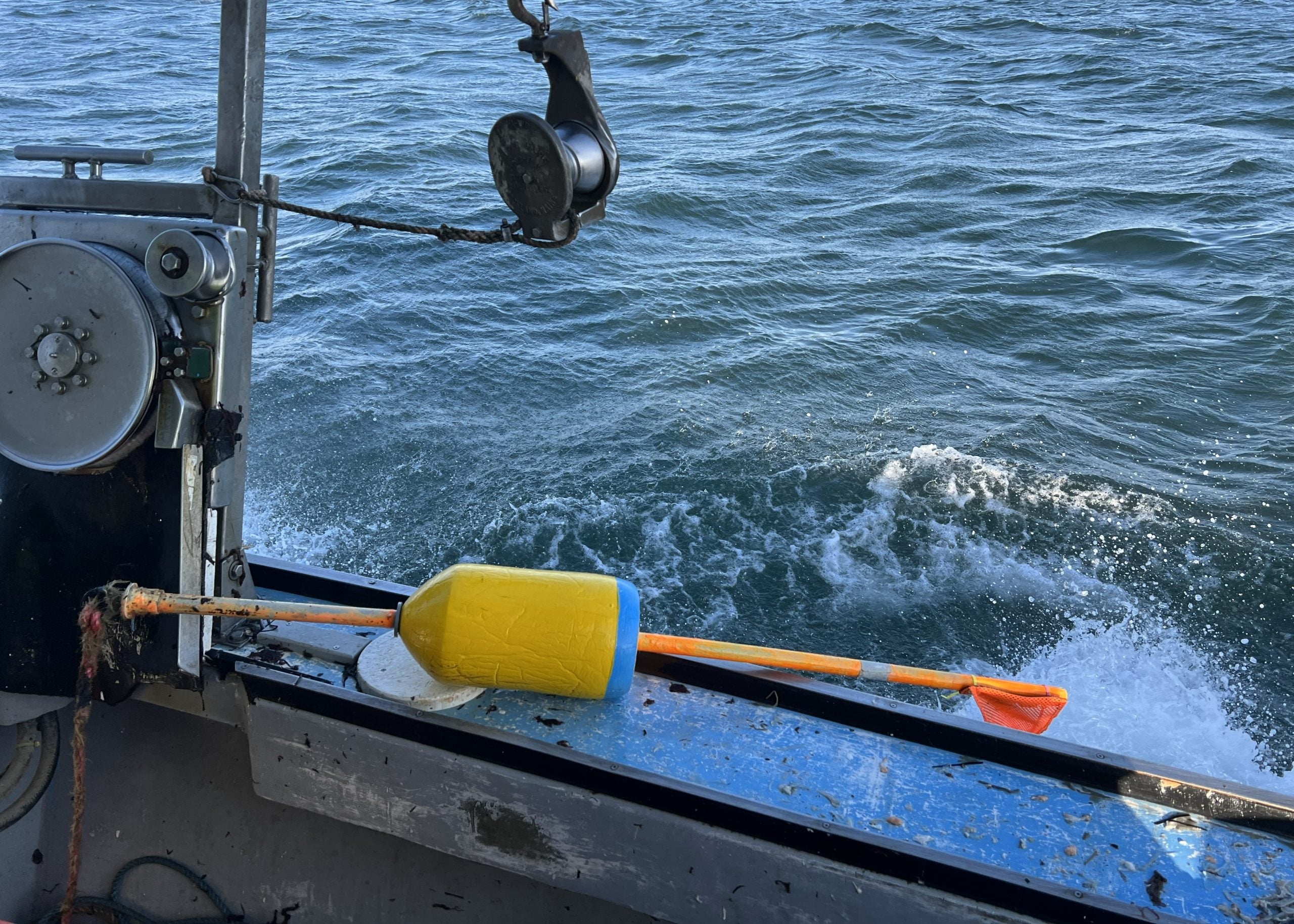
Fishing for lobsters, crabs, and some types of fish often involves fixed-gear fisheries. Unlike mobile gear where the fishing gear remains with the boat as it moves through the water, fixed gear fisheries use traps, pots, or nets that are typically set on the ocean bottom and left to fish for hours or days before they are retrieved. Current federal regulations require that this gear is marked at the surface using a static vertical line (rope) that marks each end of the gear location with a visible surface buoy. The vertical line, or rope, is also used by the fishermen to haul the gear from the bottom to retrieve the pots/traps or nets.
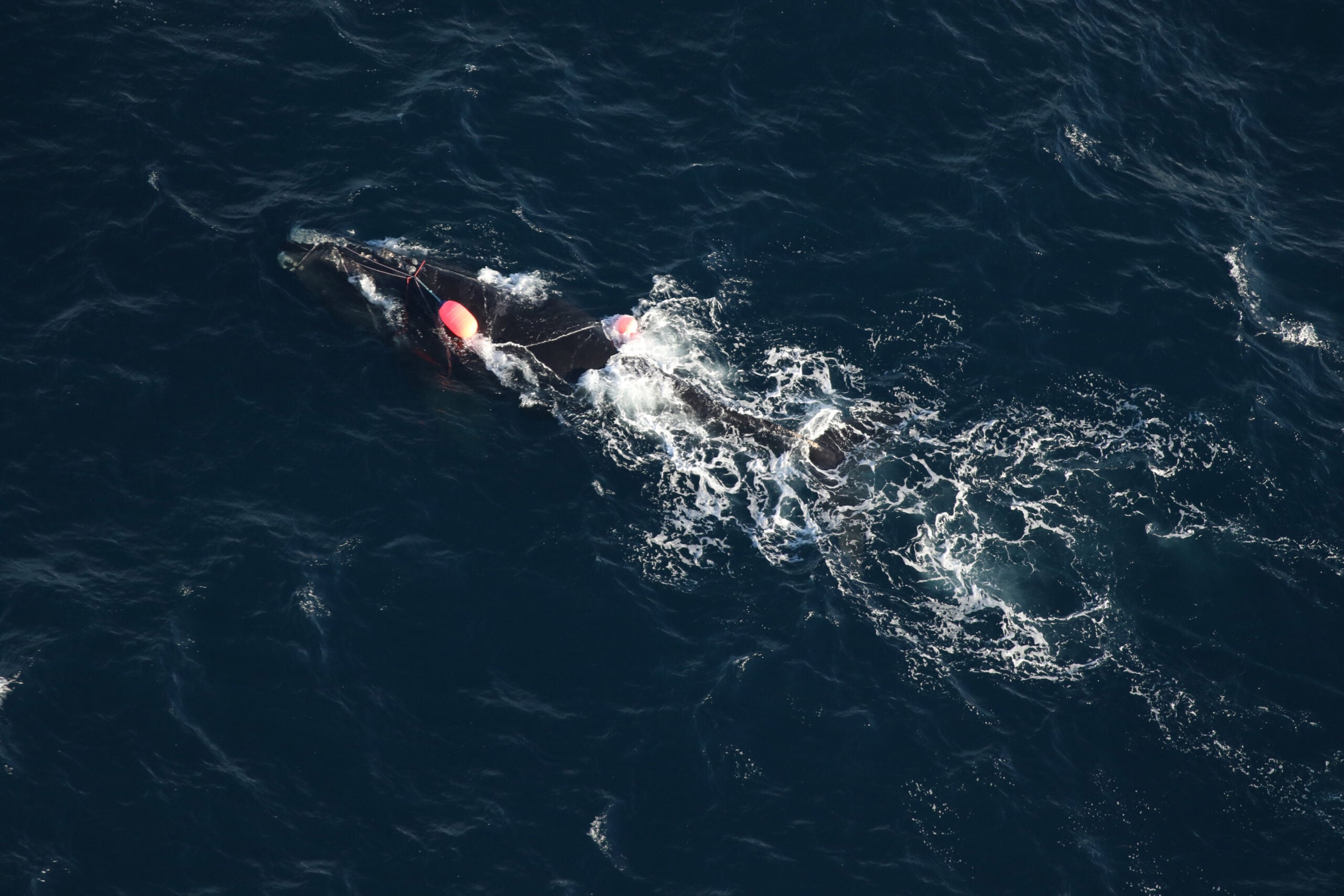
Endangered whales who feed, socialize, nurse, or migrate near the vertical buoy lines sometimes accidentally bump into a line and panic. As they roll and thrash, they cause the line to wrap around their bodies which can cut into their skin, muscle, and even bone, leading to a painful death from injuries and infections.
Entanglements are a tragic accident. Not only do they impact whales, they also negatively impact the fishing industry through loss of expensive gear, or broadscale closures which prevent fishing and can harm communities as fishing itself remains a main source of income for many families.
On demand fishing gear, also known as ropeless gear, removes the static vertical line from the water column. Fishermen use a phone app to electronically call the gear to the surface through a localized acoustic signal which does not disturb the whales. This type of gear allows both endangered whales and fishing communities to thrive!
What is on-demand fishing gear?
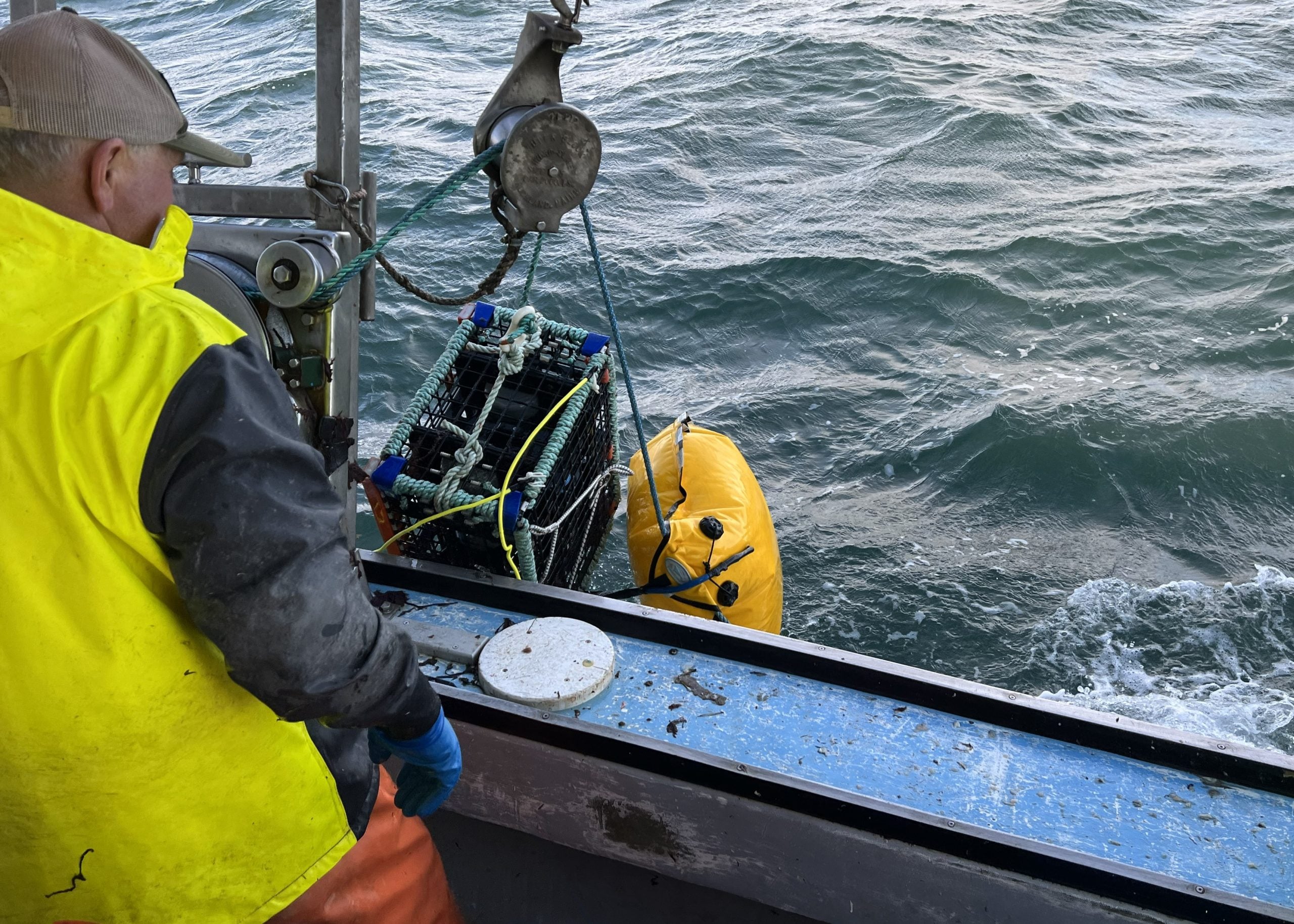

How can both whales and fishing co-exist without a risk to either of them? On-demand fishing gear!
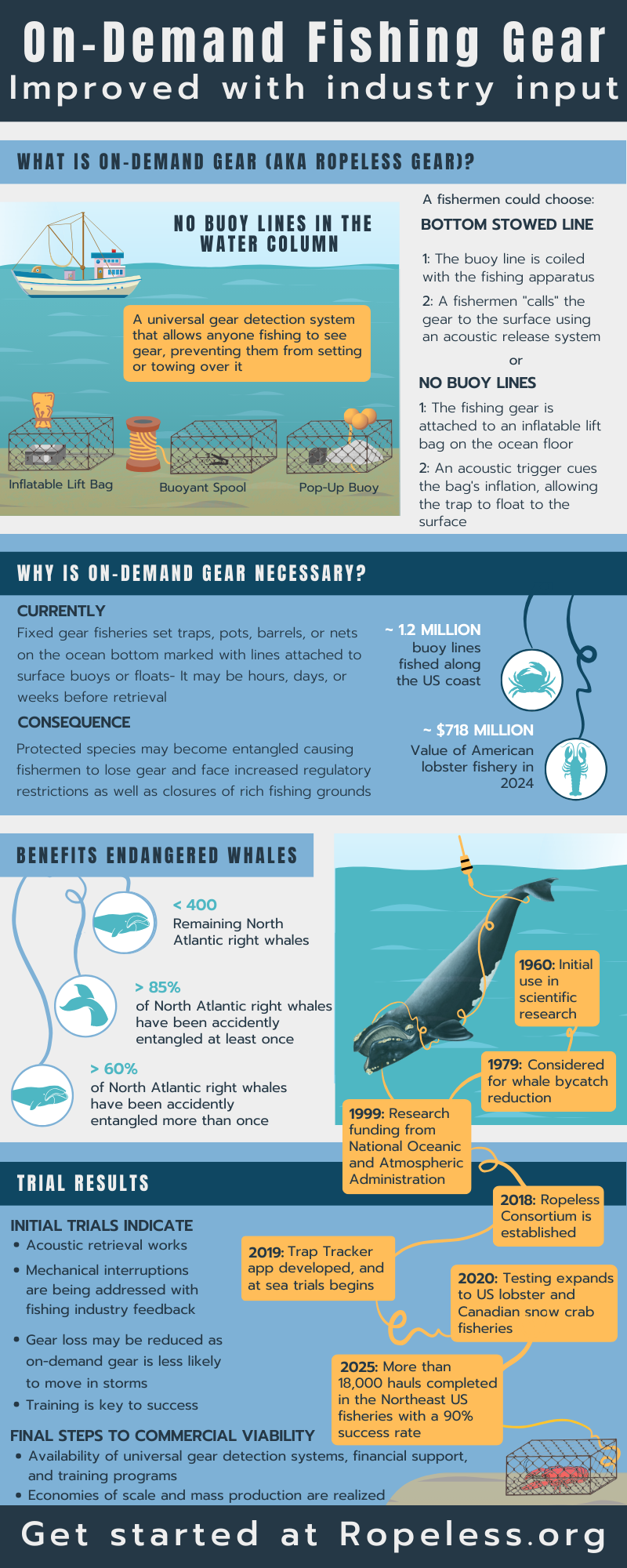
On-demand gear uses some rope, but the key difference is a change in where, when, and how long buoy lines are in the water. In some systems, the buoy line is coiled and stowed with or near the fishing gear on the ocean bottom and is only “called” to surface when a fisher is actively retrieving their gear. “Calling” the gear requires a computer system to acoustically release the buoy line, allowing it to come to the surface where it can be collected by the fisher in the same way they would for a “traditional” vertical line.
Other systems being tested do not include vertical line at all. Instead, the fishing gear is attached to a deflated bag or buoy and the fisher uses a similar acoustic trigger to cue inflation of the bag when they are ready to collect the trap. The whole system then floats to the surface.
Multiple systems are being successfully used in both the U.S. and Canada. When fishermen are initially learning to use the systems, they will often use “hybrid” trawls where an on-demand acoustic release is used on one end of the trawl while a traditional vertical buoy line remains in place on the other end of the trawl. This allows the fishermen to haul gear normally as a backup plan as they learn to use the acoustic release system. It also reduces use of endlines by 50% in those specific trawls, providing entanglement risk reduction during the initial training period.
How can on-demand fishing gear help whales?
Endangered whales sometimes accidentally swim into vertical lines in the water that connect something on the bottom (like a trap or an anchor) to something at the top (like a buoy or even a boat). Unfortunately, the common response for whales encountering a line is to roll into the gear, wrapping the line around their body. For kelp or seaweed – a natural “vertical line” – rolling easily breaks the wrap and it slides right off a whale. But for modern fishing lines, made out of tough, super-strong material designed not to break easily, this leads to an entangled whale.
Entangling lines can restrict the whales’ movements, restrict their ability to feed, cut into their flesh, and/or cause chronic infections which can eventually kill the whale. Even for those whales lucky enough to free themselves or be “disentangled” by trained and permitted professional disentanglement teams, they may still suffer long-term impacts. For example, research shows that whales who have been entangled are less likely to reproduce. Entanglement has become a leading cause of population decline for many species, particularly the critically endangered North Atlantic right whale.
The biggest source of entanglement risk to large whales in US waters is currently from buoy lines used in trap-pot fishing gear.
How fishing currently works

How on-demand fishing works

Challenges and Solutions
How is WDC helping?

WDC and its partners (NOAA Northeast Fisheries Science Center, Conservation Law Foundation, and Woods Hole Oceanographic Institution) have been working with fisherman since 2019 to trial on-demand gear under an Exempted Fishing Permit which allows them to fish without a legally mandated static vertical line and surface marking system. Since the project began, fishermen have hauled on-demand gear more than 18,000 times with a 90% success rate.
WDC is also part of the Steering Committee of the Ropeless Consortium, which provides a platform for fishers, engineers, scientists, and conservationists to share progress, collaborate on new solutions, and create a pathway toward a commercially viable on-demand fishing gear future.
WDC has secured more than $400k in funding to purchase gear and equipment for the Northeast Fisheries Science Center (NEFSC) and the Maine Department of Marine Resources gear libraries.
How can you help?
Funding is still needed to help test appropriate gear modifications for specific fisheries and support purchasing new gear. Fishers need to test different types of on-demand systems to determine which system works best for their particular fishery. Input from fishermen using the gear has been instrumental in improving gear performance.